Jul 4, 2026
2026 World Cup winner predictions - Every remaining nation ranked by probability [Rd. of 16]
Read Article 
How Soccer World Cup betting odds really work, and why they move so fast: a simple guide to understanding betting lines ahead of World Cup 2026.
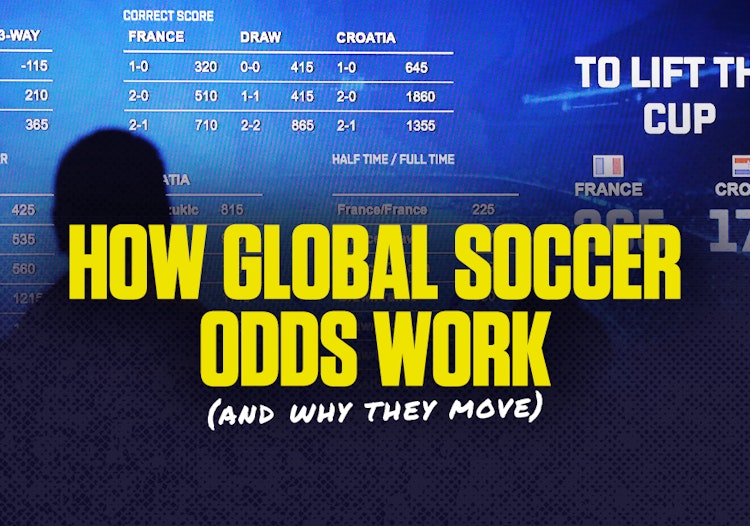
This World Cup brings more volatility, more global betting activity, and faster market movement than many fans are used to seeing.
If you’re new to sports betting, World Cup odds can feel like a language of their own. Why do they shorten? Why do favorites drift? Who actually decides the numbers in the first place, and what do they even mean?
The first trick to understanding how odds work is reading them through the lens of value. World Cup odds aren’t static predictions—they’re prices. Costs shaped by probability, oddsmaker judgment, betting activity, and market pressure.
In this guide, we’ll explain how Soccer World Cup odds work, what causes them to move, and how to read betting markets with a clearer understanding of what the prices really represent.
The way betting markets work is simple: a sportsbook or prediction market offers a price for an outcome based on how likely it is to happen. That can be as straightforward as a 50/50 coin flip, or as complex as a mix of multiple performance and market variables.
At its core, odds are simply probabilities expressed as prices.
Once you understand that, everything else becomes easier to read.
In practice, odds are shown in different formats depending on the market. In the US, you’ll often see American odds (while decimal odds are common globally)—but they all represent the same thing: implied probability.
A simple way to read any odds:
This applies across all World Cup markets, whether you’re looking at outright winners, individual matches, or player props (e.g., goals scored and shots attempted).
But importantly, these numbers aren’t "truth"—they are estimates shaped by data, bookmaker pricing, market behavior, and trading activity.
The gap between probability and price is where value can emerge.
Learn more about how sportsbooks set their prices in our guide on where sports odds come from.
Sportsbooks don’t aim to predict outcomes perfectly—their job is to price markets in a way that protects their business.
They do this by building a small commission, known as the vig (or juice), into every set of odds.
If you add up all World Cup winner odds in a market, the total implied probability will usually land between 110% and 120%.
That extra percentage is the bookmaker’s margin.
What that means in practice:
It’s a small structural detail, but it underpins every price you see.
Prediction markets can operate differently, with prices determined directly by market participants rather than traditional bookmaker margins.
Discover what else the bookmaker’s lines are telling you in our guide on how to read sports betting odds.
World Cup odds don’t start fixed — they evolve over time.
Pre-match analysis shapes early prices, including team strength, historical performance, and statistical projections. As kickoff approaches, real-world information, betting activity, and trading volume play a much larger role.
The typical pattern:
By the time you’re looking at World Cup final markets, most obvious pricing inefficiencies have already been corrected.
Earlier markets carry more uncertainty—but also more opportunity for value.
The takeaway here is merely, pay attention to when you’re checking the odds. This will give you a measure of where the value is.
Dive deeper into how markets adjust over time in our guide on sports betting line movement.
The Soccer World Cup isn’t just a betting market—it’s a global event.
That means certain teams consistently attract attention, regardless of price.
Argentina, Brazil, England, and Spain tend to draw steady betting interest. Not always because they’re undervalued. Because they’re familiar.
That demand affects pricing across both sportsbooks and prediction markets.
The effect:
This is why some of the most popular teams can be among the least efficient options in betting odds on the World Cup markets.
For an overview of recent tournament betting shifts, learn more in our guide on recent moving World Cup odds.
Not all betting activity is equal.
Sharp bettors—those working with models, data, and discipline—tend to have a stronger influence on odds than casual bettors.
Sharp activity can influence both sportsbook odds and prediction market pricing.
When sharp money enters the market:
These moves are often more meaningful than slow, public-driven changes.
You don’t need to follow every shift, but understanding what caused it helps you read the market more clearly.
For a sharp analysis of the current favorites, take a look at our data-driven breakdown of the World Cup 2026 favorites.
Some of the biggest movements have nothing to do with long-term trends. They’re driven by new information.
Common triggers:
In high-profile matches, especially leading into the final, even small updates can influence the odds of final World Cup pricing.
The key difference is timing.
By the time most bettors react, the market often already has.
Stay on top of tournament updates with our World Cup news—updated daily.
This year’s World Cup introduces a few new dynamics that are worth paying attention to.
These aren’t always obvious in the odds, but they can influence performance over time.
For bettors, that means a slightly less stable market, particularly in earlier rounds and futures.
It’s one more layer to consider when evaluating betting odds for the World Cup.
Learn more about how to approach this year’s tournament in our simple guide on how to bet on the 2026 World Cup.
Odds movement can look random at first. It usually isn’t.
Most shifts fall into a few patterns:
The goal isn’t to chase movement. It’s to understand what’s behind it.
That context is often more useful than the number itself.
Learn more tips in our guide on how to read betting odds.
It’s easy to assume that if odds are moving, they must be “right.”
But odds don’t predict outcomes—they reflect market activity.
A team shortening in price doesn’t guarantee a win. It only tells you how the market is behaving.
That distinction is important, especially in high-volume markets like odds for World Cup final bets.
Learn how to avoid the typical traps with our guide on the most common sports betting mistakes.
There’s no single “best” time to bet. But there are trade-offs.
For World Cup winner odds, early positions can offer stronger long-term value—but they require patience and a clear view of the price.
In most cases, the focus should stay the same: is the number better than it should be?
For a forward-looking view of some betting edges, take a look at our breakdown on how predictive analytics can find early hidden value.
Dimers Pro is your secret weapon for spotting if the odds offer value or not.
Catch where the prices don’t match the underlying chances—so every decision is backed by an edge you can actually measure.
With Dimers Pro, you access the full line-up of soccer betting insights:
Beyond our soccer expertise, you’ll also unlock:
Start your free trial now and pay $0 for 3 days — cancel anytime.
Understanding World Cup odds doesn't just help your decision-making; it also helps you bet with discipline. That’s at the core of everything we do at Dimers: using data and probability to make bets rationally, not emotionally. It’s crucial to always stay in control and bet within your financial limits. If you have concerns about your betting, seek help through our responsible gambling resources.
World Cup odds represent the implied probability of an outcome, converted into a price that shows potential return. Shorter odds indicate a higher chance of success, while longer odds suggest a lower probability but a bigger payout. These prices can be shaped by statistical models, betting or trading activity, and sportsbook margins.
World Cup odds move because sportsbooks and prediction markets update prices to reflect new information and betting pressure. Sharp money, public betting trends, injuries, and confirmed lineups are the main drivers of change. These adjustments help oddsmakers balance risk while keeping prices aligned with the latest available data.
Bookmakers set opening World Cup odds using statistical models that factor in team strength, squad depth, historical performance, and qualification results. They also account for tournament structure and external conditions. Once the odds are released, they begin shifting immediately based on betting action and incoming news.
Shorter odds are not always better value because they only reflect higher implied probability, not certainty or fairness. A heavily backed team can be overpriced if public sentiment outweighs true probability. Value exists when the price offered is higher than the actual likelihood of the outcome occurring.
Traditional sportsbooks set odds using statistical models, market data, and risk management. In a prediction market, instead of a bookmaker setting the price, users buy and sell positions on outcomes in a market-driven environment. Both systems price probability. Sportsbook odds are managed by bookmakers. Prediction markets are driven by participants trading with one another.


Kieron Byatt brings 18 years of experience in media and digital content to his role as Senior Writer at Cipher Sports Technology Group. A passionate sports bettor and fantasy manager, Kieron closely follows NFL, NBA, and EPL, with strong interest in MLB and NHL.