Jul 15, 2026
England vs. Argentina prediction, odds, props, World Cup 2026 picks [Semi-Final]
Read Article 
11 common betting mistakes to avoid during World Cup 2026—protect your bankroll by dodging the most typical bad habits.
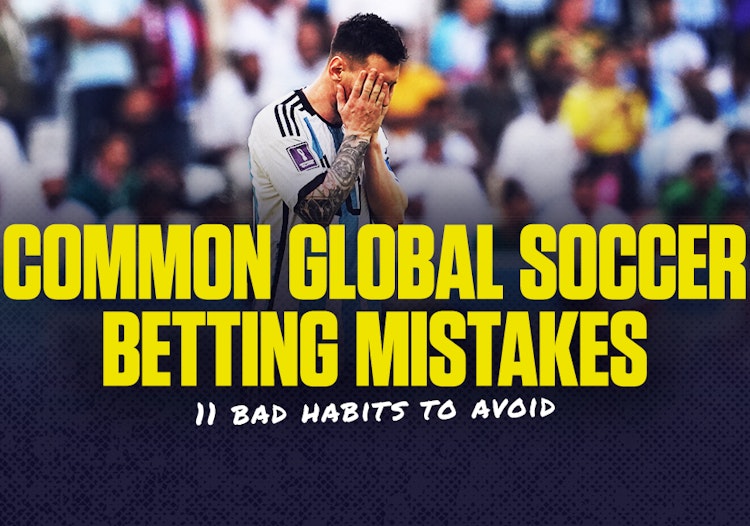
The World Cup isn't just one of the biggest betting events in sports. It's also one of the easiest places to make expensive mistakes.
In 2026, the scale increases. More teams. More matches. More opportunities to bet—and more chances for emotion, hype, and overconfidence to influence decisions.
It's easy for bettors to fall into habits that hurt long-term results. Overreacting to recent results. Ignoring value. Betting emotionally. These are all common traps during major tournaments.
Many of these mistakes don't feel irrational in the moment. A heavily favored team looks "safe." A hot streak feels meaningful. A big loss feels recoverable.
Successful betting during the World Cup is rarely about predicting every result correctly. It's about making disciplined decisions consistently over the course of the tournament.
To help you avoid the typical traps of major tournaments, here are the 11 most common World Cup betting mistakes. Avoid them, and you're already ahead of most bettors.
One of the most common World Cup betting mistakes is treating odds as fixed predictions rather than market prices. Odds don't tell you what will happen. They reflect what the market believes is likely to happen, adjusted for sportsbook margin and public betting behavior.
A heavily favored team may still be a poor bet if the price is too short relative to its true chances of winning. Likewise, an underdog can offer value even if it's less likely to win outright.
Sharp bettors don't ask, "Who will win?" They ask, "Does this price accurately reflect the probability of that outcome?" Understanding odds as prices rather than predictions is key to betting more rationally throughout the tournament.
To go deeper into how these concepts apply in practice, see our simple guide on how to bet on World Cup 2026.
The World Cup creates more noise than almost any other betting event. Public narratives and emotional storylines can quickly overwhelm objective analysis. Instead of reacting emotionally, look at measurable indicators like probabilities and edge ratings.
Within that approach, one of the biggest betting mistakes is misunderstanding probability itself. A 64.5% win probability does not mean a bet is guaranteed to hit. It means that the outcome is expected to occur roughly 64 times out of 100. The other 36 still exist.
Good bets can still lose. Bad bets can still win. What matters in the long term is whether the probability of an outcome is greater than the odds imply.
The best bettors use data to identify where public perception and actual probability begin to separate. Data doesn't eliminate uncertainty, but it helps clarify potential value and keep decisions grounded in reality.
Get a more profound view of how analytics uncover value in football markets in our guide on predictive betting insights.
Picking winners is not the same as betting profitably. A team can win and still be a bad bet if the odds offered are shorter than the true probability justifies.
This is where positive expected value (+EV) matters—when the implied probability in the odds is lower than the assessed probability of the outcome happening. That edge is where long-term profit lives.
The goal is not simply to be right more often than wrong. It's to consistently place bets where the price offers value relative to the risk. Your real edge comes from identifying pricing gaps when the market gets it wrong.
To see how sportsbooks actually price World Cup markets and why odds shift over time, read our guide on how World Cup odds work.
Instinct feels powerful, especially during major tournaments. Watch enough soccer, follow enough headlines, and suddenly a bet "just feels right."
Intuition often reflects bias rather than insight. It tends to outweigh memorable moments, recent highlights, and emotional narratives. Experience and pattern recognition still matter. But a gut feeling should support analysis, not replace it.
The strongest betting decisions happen when your instincts align with data and market value, not when emotion drives the pick alone.
For a closer look at the core principles that every bettor should understand before placing a wager, see our guide on the 20 things every sports bettor should know.
The World Cup introduces bettors to teams and players they may rarely follow. That creates opportunity, but also risk. Betting on unfamiliar teams based on surface-level narratives is one of the easiest ways to misread a market.
Without context, it's easy to overestimate form or misunderstand quality. The World Cup rewards preparation. But research doesn't mean you need to spend hours investigating matches. Dimers' global soccer predictions and best bets simplify research across every match day.
If you're unfamiliar with a team, get familiar before you stake a wager. To get acquainted with how different nations are stacking up, see our World Cup 2026 power rankings.
Few betting mistakes are more common than overreacting to what happened most recently. A team wins convincingly and suddenly looks unstoppable. This is recency bias in action.
Confirmation bias worsens it by encouraging bettors to only notice information that supports their existing opinion. If you already believe a team is a contender, you're more likely to treat positive results as proof while dismissing warning signs.
Not every hot streak is meaningful. Not every bad result changes underlying quality. The ability to separate signal from noise is one of the biggest edges a bettor can develop.
To see how betting markets adjust to new information over time, read our guide on understanding line movement in sports betting.
The World Cup's daily match volume creates constant temptation to increase stakes, chase "locks," or overexpose your bankroll on high-profile matches.
Bankroll management means risking only a small, consistent percentage of your betting funds on each play, often referred to as betting in "units." Instead of wagering random amounts based on confidence or emotion, disciplined bettors keep stake sizes structured and repeatable over the course of the tournament.
This keeps losses manageable and protects against the variance that comes with soccer betting. The goal is sustainability, not short bursts of aggressive betting. Discipline keeps you positioned for stronger opportunities later in the tournament.
No single match should ever define your bankroll.
To understand the core habits that separate casual bettors from consistent ones, see our guide on the three key things every sports bettor should know to turn a profit.
Many bettors place their bets at the first sportsbook they open. That leaves value on the table. Odds vary across books, often by enough to meaningfully impact long-term results.
Line shopping means comparing available odds before placing your wager. This gives you the best possible number and increases expected value without changing your analysis.
Professional bettors treat this as standard practice. If two books offer different prices on the same market, always take the better number.
To compare trusted sportsbooks and find the best available odds in your state, see our breakdown of the best sports betting sites in 2026.
Losses are part of betting. Chasing turns normal variance into reckless decision-making. After a tough result, it's tempting to increase stakes or force extra bets to "win it back." That reaction is emotional, not analytical.
The World Cup makes this especially dangerous because matches come quickly and there's always another betting opportunity around the corner. That constant action can make impulsive recovery betting feel justified, but it isn't.
Sharp bettors accept losses as part of long-term variance. They reassess calmly and stick to their staking strategy. The goal is consistency, not immediate recovery. Trying to erase losses quickly often creates bigger mistakes than the original losing bet itself.
To learn how to stay disciplined through losing runs, see our guide on how to handle cold streaks and bad beats in sports betting.
More betting does not mean more edge. The World Cup offers huge market volume, but not every match presents value.
Betting simply because matches are available usually leads to lower-quality decisions. They force plays on weak reads, chase entertainment, or convince themselves every opinion deserves a stake.
Selective betting is a skill. Passing on marginal spots preserves your bankroll for stronger positions later. The edge is in quality, not quantity. Sometimes the wisest World Cup bet is no bet at all.
For a broader breakdown of recurring betting pitfalls, see our guide on the most common sports betting mistakes.
If you're not recording your bets, you're guessing about your efficiency. Tracking reveals patterns that memory can't. It shows which markets you actually beat, where you lose value, and whether your process is improving over time.
Without records, it's easy to overestimate success and ignore repeated mistakes. Effective bettors don't rely on memory. They rely on evidence.
To keep your soccer betting research and insights organized in one place, explore the Dimers app.
Most World Cup betting mistakes aren't about bad luck. They're process gaps.
Misreading odds, chasing emotion, and betting without structure all compound over time.
The most successful bettors approach the tournament with discipline, data, and patience. Your edge comes from consistently avoiding avoidable mistakes.
That's what turns betting from reaction into strategy.
Dimers Pro is built to avoid the most common betting mistakes.
Instead of falling for the classic traps, every bet you make using Dimers Pro is sharp by default. You can quickly spot value and the underlying probabilities, along with a wide range of tools and insights, so you don't miss any valuable betting angle.
With Dimers Pro, you access the full lineup of soccer betting insights:
Beyond our soccer expertise, you'll also unlock:
Start your free trial now and pay $0 for 3 days—cancel anytime.
Avoiding common betting mistakes is the foundation of disciplined betting. Dimers is built around using data to make betting decisions more logical. The simplest rule for betting responsibly is to always stay in control and stay within your financial means. If you’re struggling with your betting, seek help through our responsible gambling resources.


Kieron Byatt brings 18 years of experience in media and digital content to his role as Senior Writer at Cipher Sports Technology Group. A passionate sports bettor and fantasy manager, Kieron closely follows NFL, NBA, and EPL, with strong interest in MLB and NHL.