Aug 20, 2026
Best bets today for all sports: Thursday's picks include Sun vs. Aces WNBA play [8/20/2026]
Read Article 
If you approach casino gaming with an analytical mindset, you already know that flying blind is the quickest way to deplete your bankroll. In the world of online slots, the bright lights and engaging themes are just the window dressing. Beneath the surface of every game is a complex, heavily regulated mathematical engine designed to dictate exactly how and when the game pays out over time.
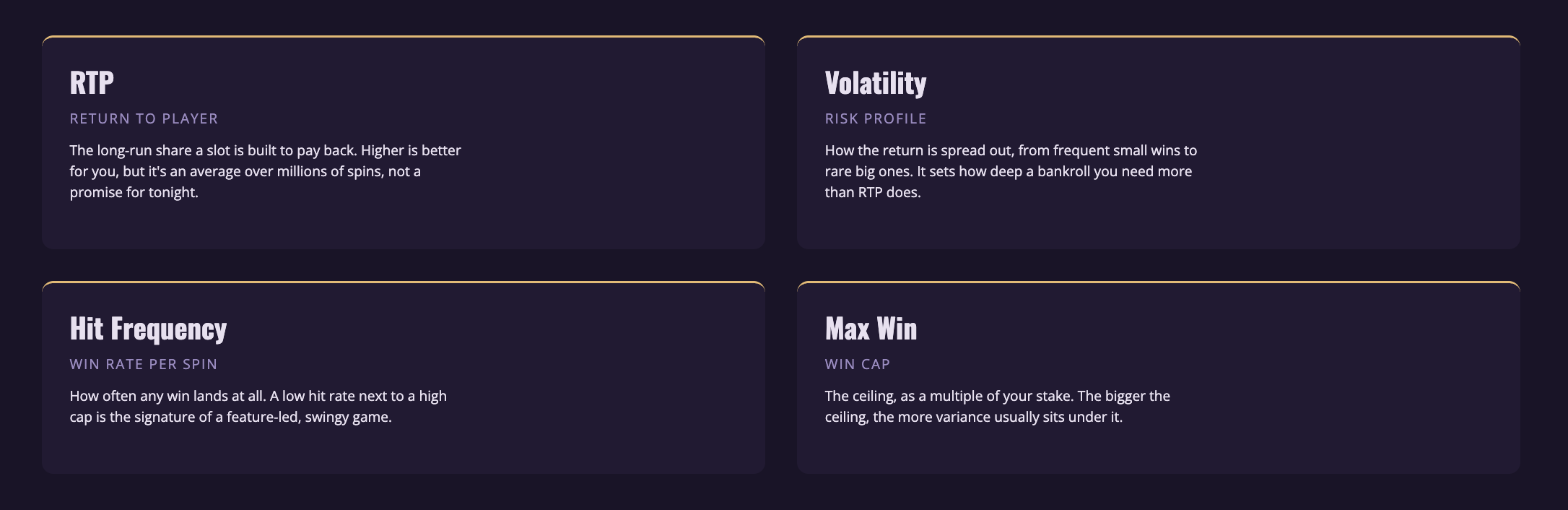
For players trying to make informed decisions before they risk their own money, there are two critical metrics you will encounter on almost every modern game: RTP (Return to Player) and Volatility (sometimes called variance).
At first glance, these numbers seem like the cheat code to picking a winning game, but misunderstanding them is a quick way to bust your bankroll. If you want to stop guessing and start playing with a mathematical edge, you need to consult the experts. The team at MaxSpinz has created an industry-leading slots mechanics guide that completely demystifies the complex math behind modern iGaming. Drawing directly from their comprehensive research, let's break down the true relationship between RTP and volatility, and what these numbers actually mean for your next session.
Return to Player (RTP) is presented as a percentage. It represents the theoretical amount of money a specific game will pay back to players over an infinite number of spins. For example, if a game has an RTP of 96%, the math dictates that for every $100 wagered, the machine will eventually return $96 in winnings, keeping $4 for the casino (this $4 is the "House Edge").
Here is where the misconception lies: players often assume this 96% return applies to their specific session. It does not.
RTP is calculated over millions, sometimes billions, of simulated spins. Over a short sample size—like a Friday night session of 500 spins—the actual return can deviate wildly from the theoretical average. You might hit a massive multiplier and walk away with a 400% actual return, or you might hit a cold streak and see a 30% return.
RTP is an incredibly useful metric for understanding the fundamental fairness and baseline house edge of a game, but it is practically useless for predicting what will happen in your next 50 spins. It is the destination, not the journey. To understand the journey, you have to look at volatility.
If RTP tells you how much a game pays out over its lifetime, volatility tells you how it pays out. Volatility measures the frequency and size of the payouts. It is the risk factor of the game, dictating the swings your bankroll will experience.
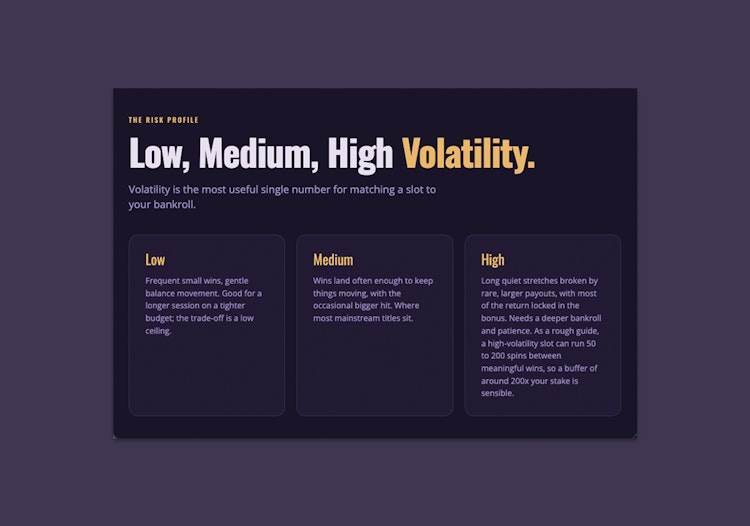
Casino operators generally classify volatility into three main buckets:
1. Low Volatility: These games are designed for steady, prolonged play. They pay out frequently, but the wins are usually small—often just returning your initial bet or slightly more. Low volatility games are perfect for players with smaller bankrolls who want to extend their entertainment time and clear bonus wagering requirements safely. The risk of rapidly busting your bankroll is low, but the chance of hitting a massive, life-changing jackpot is equally low.
2. High Volatility: These games are the exact opposite. They are characterized by long dry spells where you might spin dozens of times with little to no return. However, when they do pay out, the wins can be massive. High volatility games often feature heavy multipliers, complex bonus rounds, and expanding wilds. They require a larger bankroll and a stomach for risk, as you have to weather the cold streaks to give yourself a chance at the game's maximum potential.
3. Medium Volatility: As the name suggests, these strike a balance. You will see a mix of smaller, regular base-game hits with the occasional opportunity for a moderately sized bonus feature.
Now, let's look at why understanding the intersection of these two metrics is vital. Imagine you have two different games sitting side-by-side in an online lobby. Both boldly advertise an RTP of exactly 96.00%.
Game A is a classic fruit machine with low volatility.Game B is a complex, modern video slot with high volatility.
If you start with a $100 bankroll and bet $1 per spin on Game A, you will likely see your balance hover between $80 and $110 for a long time. The game will constantly feed you $1, $2, and $5 wins. It feels active. It feels fair. Your bankroll is slowly bleeding to the 4% house edge, but you are getting hours of entertainment.
If you take that same $100 and bet $1 per spin on Game B, your experience will be completely different. You might spin 30 times and win absolutely nothing. Your bankroll plummets to $70, then $40. Suddenly, on your 85th spin, you trigger a bonus round that drops a 500x multiplier, catapulting your balance to $500.
Both games are operating perfectly within their math models. Both will eventually reach that 96% RTP over a billion spins. But your localized experience—the "feel" of the game—is dictated entirely by the volatility.
Before you make a deposit and load up a game, you need to align the game's math profile with your personal goals and bankroll constraints.
If your goal is to have fun for three hours on a $50 budget, loading up an extreme-volatility game is a mathematical error; you are highly likely to hit a variance downswing and bust your balance in 15 minutes. Conversely, if you are chasing a massive payout and don't mind the risk of a quick loss, a low-volatility game will frustrate you with endless tiny payouts that never move the needle.
Taking the time to understand these underlying mechanics is what separates casual gamblers from informed players. By treating your casino sessions with a data-driven approach, you can protect your funds and maximize your entertainment value.
The numbers published by game developers are not marketing gimmicks; they are precise mathematical blueprints. RTP tells you the price of admission over the long haul, while volatility tells you how bumpy the ride will be. By utilizing resources like the MaxSpinz guide to read both, you can stop relying purely on luck to pick your games, and start using data to find the exact type of casino experience you are looking for.


Mac Douglass specializes in NFL previews for the NFC South and NFC East, MLB best bets, Formula 1 race previews, and professional tennis insights. Combining predictive simulations and data-driven sports analysis, Mac provides in-depth content to elevate the betting experience for sports fans.