Hosting the 2026 World Cup kicked off an incredible wave of
soccer betting
in America. According to a July 2026 study conducted by Dimers.com,
68%
of Americans who bet regularly placed at least one wager during the tournament. For
1 in 6, it was their first time placing a sports bet.
The study "Heart vs. Data Index 2026: Did Americans Bet with Their Hearts or the Data During the World Cup?" looked into how Americans chose their bets: trusting their gut, taking advice from friends and family, following social media touts, or relying on predictive models, data, and stats.
Key Findings
- 68%
of American bettors placed a wager on the 2026 World Cup. Among these,
31%
finished the tournament in profit.
- 51%
backed Team USA
even when the odds and models made them clear underdogs.
- 39%
of bettors using data models won money, while gut-feeling bettors lost money at more than double the rate of those who took an analytical approach.
- 41%
of bettors who relied on social media touts lost money.
- On average, Americans spent
$52
per game, with
California
and
Texas
taking the crown with an average of
$69
per game.
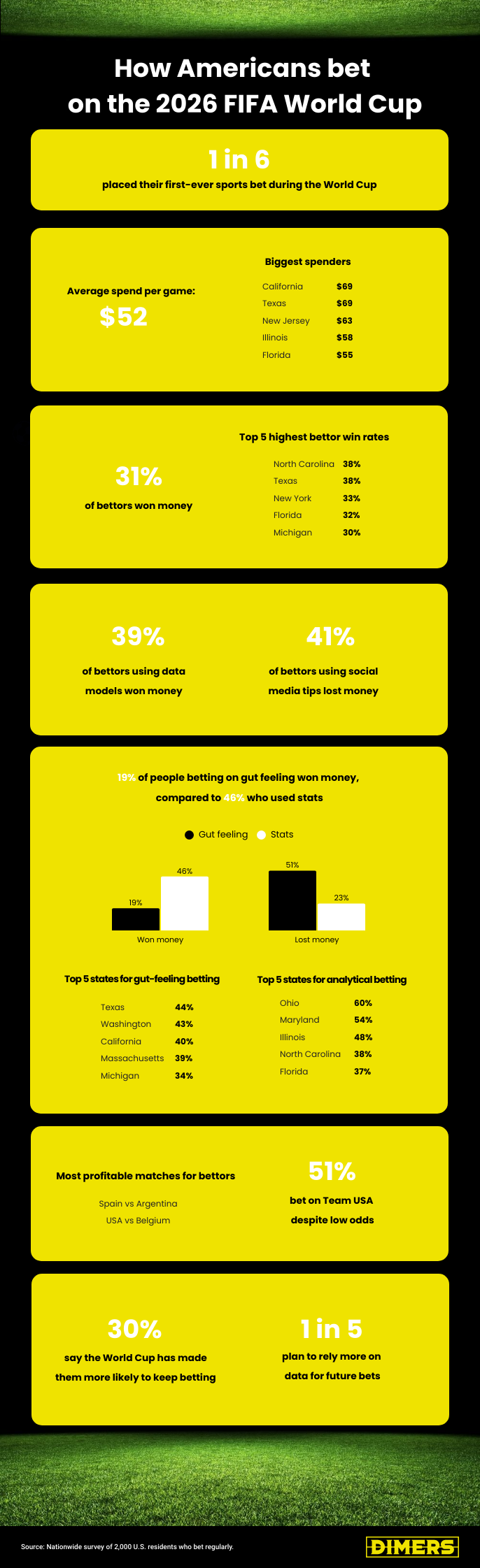
How Americans Bet on the World Cup
The World Cup didn't just bring in new viewers—it introduced millions of Americans to soccer
betting sites. Among those who placed a wager,
61%
had
never bet on a soccer
match before. For
17%, it was their very first time placing
any sports wager.
On average, Americans spent
$52
per game.
Budget Check: California and Texas Top the Spending List
California and Texas
tied for the top spot, with
fans spending 33% more per match
than the national average of
$52. In fact, 5 states averaged higher spend per game than the national average:
- California:
$69
per game
- Texas:
$69
per game
- New Jersey:
$63
per game
- Illinois:
$58
per game
- Florida:
$55
per game
The "Patriotism Tax": When Heart Overrules the Odds
The tournament highlighted just how much national pride can influence financial decisions.
51% of bettors backed the United States
even when predictive models and oddsmakers made them heavy underdogs.
1 in 8
admitted to doing this multiple times throughout the tournament. It’s "Patriotism Tax"—the financial price fans pay when backing their home team despite the odds.
Even analytical bettors weren't immune.
55%
of bettors who used data models still placed at least one wager on Team USA despite the unfavorable odds.
Heart Bettors Vs. Analytical Bettors
The survey revealed two distinct camps: "Heart Bettors", who relied on gut feelings and personal advice, and “Analytical Bettors”, who used probabilities, stats, and predictive models.
29%
admitted they picked their bets based on instinct or recommendations from friends and family.
However, those
gut-driven decisions often led to blown budgets. Almost
1 in 4
of emotion-led bettors spent more than planned, compared to
19%
of analysis-focused bettors. The states with the highest percentage of gut-feeling betting:
- Texas:
44%
- Washington:
43%
- California:
42%
- Massachusetts:
39%
- Michigan:
34%
Despite delivering far better results,
only 16% of bettors used analytical models—such as those provided by Dimers.com—to guide their wagers. The top states for analytical betting were:
- Ohio:
60%
- Maryland:
54%
- Illinois:
48%
- North Carolina:
38%
- Florida:
37%
Another group turned to platforms like TikTok, X, Discord, and YouTube for picks. But the data shows that taking advice from social media influencers was one of the worst strategies of the tournament:
41% of bettors who relied on social media lost money.
These tout-reliant bettors wagered more than the national average, topping
$55 per match
and
suffering losses 7 times more often
than other groups.
Social media touts were most popular among bettors in
Florida,
Texas,
New York,
California,
Michigan,
Ohio,
Georgia, and
Illinois.
After the tournament,
28%
of bettors who followed social media touts said they plan to switch to a data-driven approach.
Emotion Costs You, Data Protects Your Bankroll
Overall,
about 31% of World Cup bettors finished the tournament in profit. The top five states with the highest percentage of winning bettors were:
- North Carolina:
38%
- Texas:
38%
-
York:
33%
- Florida:
32%
- Michigan:
30%
The study's verdict is clear:
51% of gut-feeling bettors lost money, compared to
24%
of those who trusted the math — while only
19%
turned a profit, compared with
46%
who won money among the data-driven crowd.
Despite delivering far better results,
only 16% of bettors used analytical models—such as those provided by Dimers.com—to guide their wagers. The top states for analytical betting were:
- Ohio:
60%
- Maryland:
54%
- Illinois:
48%
- North Carolina:
38%
- Florida:
37%
The World Cup's Lasting Legacy
The FIFA World Cup's impact on American gambling habits will likely linger long after the final whistle.
30% of respondents say the tournament made them more likely to bet on sports in the future. More importantly, it changed how they plan to bet.
1 in 5 bettors (21%) plan to use more stats, models, and analytics for upcoming sports seasons.
Methodology
In 20th July 2026, Dimers.com surveyed 2,000 U.S. adults who bet regularly to analyze betting behavior during the 2026 FIFA World Cup. The sample included men (50%), women (49%), and non-binary (1%) respondents, with an average age of 38 years. Respondents were surveyed on their wagering frequency, average spend per match, decision-making sources, and overall financial outcomes. Data was cross-referenced to compare the performance of gut-feeling bettors, social media tipster followers, and users of predictive data models (not to be confused with
prediction market apps). State-by-state breakdowns were also mapped to identify regional spending habits, emotional betting levels, analytics adoption, and net profit rates. The following states were excluded from the study due to insufficient data: Louisiana, Mississippi, Arkansas, Hawaii, Utah, Vermont, Maine, Montana, Nebraska, North Dakota, New Hampshire, New Mexico, Idaho, Rhode Island, Alaska, South Dakota, Wyoming.
If you or someone you know is struggling to gamble responsibly, these free, confidential resources can help:

To make sure you get accurate and helpful information, this guide has been edited by
Ryan Leaver
as part of our fact-checking process.
Advertiser disclosure


 Available with Dimers Pro